
Montessori
What it actually looks like at half past eight on a Tuesday
Montessori has accumulated a lot of theory around it. Here is the practical version — what your child would be doing, and why anyone thinks it works.
Independence
Concentration
Mixed ages
A prepared environment
Learning at their own pace
Hands before heads
The work cycle
Three hours, uninterrupted
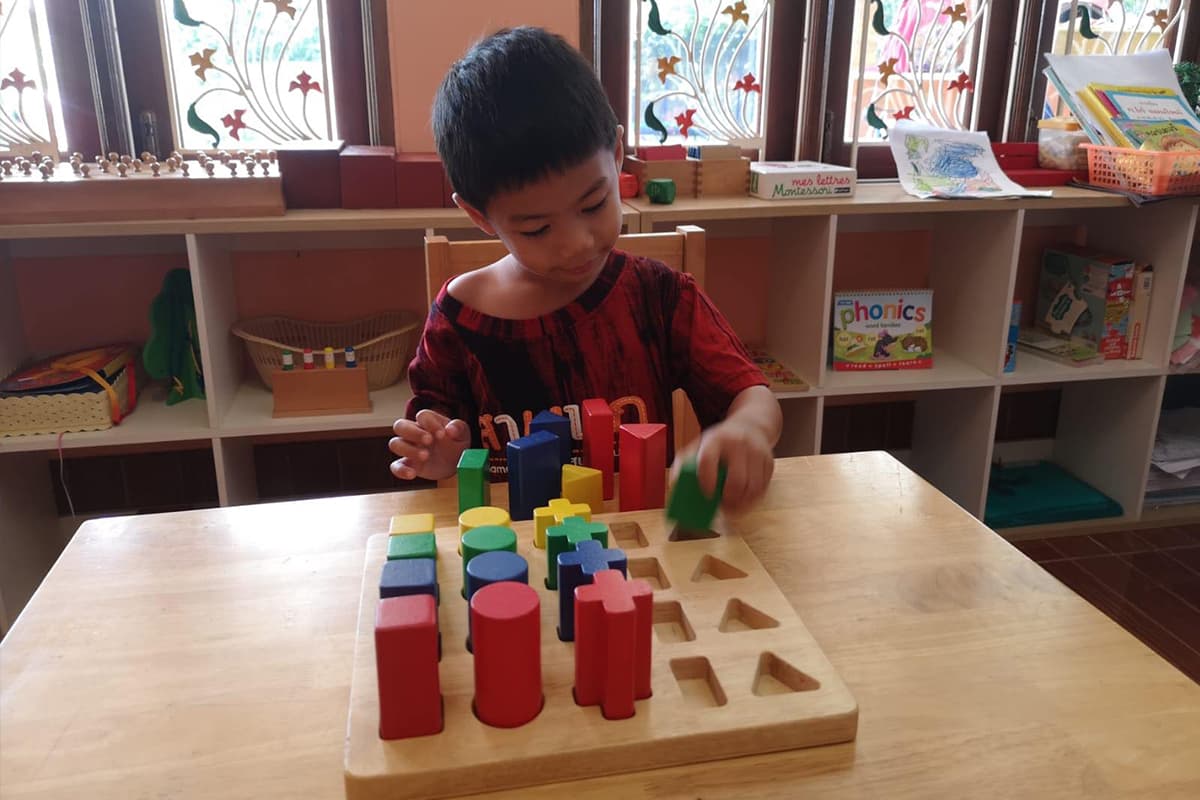
The heart of a Montessori morning is a long, unbroken work period. A child chooses something, carries it to a table or a mat, works with it for as long as it holds their attention, and puts it back.
It sounds unstructured. It is the opposite — the structure is in the room and in the materials, which is why nobody has to spend the morning keeping order.
The rule that matters most is that a child who is concentrating is never interrupted. Not by a teacher, not by a bell, not to move on to the next thing. That is where attention span is built, and it is the single clearest difference from a conventional preschool timetable.
Curriculum
What is actually in the room
Montessori materials, plus the general subjects you would expect from any good early years school.
Montessori areas
- Practical life
- Sensorial
- Language
- Mathematics
- Cultural studies — botany, geography, history, science, zoology
General subjects
- English
- Thai
- Arts and crafts
- Drama
- Physical education
- Computer studies
- The ‘Stay Safe’ programme
Extra-curricular
- Cooking
- Music
- Yoga
- Swimming lessons
Swimming lessons are charged separately.
Mixed ages
Why a three-year-old and a five-year-old share a room
This is the part that surprises parents most, and it is deliberate.
1½ – 2½ years
Playgroup
2½ – 4 years
Junior Montessori
4 – 6 years
Primary Montessori
An older child who explains something to a younger one finds out very quickly how well they actually understand it. A younger child watching an older one gets a preview of where they are heading, offered by someone close enough to be credible.
Because roughly two-thirds of a class return each year, the room has a memory. Children arrive into a culture that is already running, and they learn how it works from the children rather than from the adults.